GLY522 Homework #4 Spring 2000
1. Batch reactions are carried out between Benzene and a loamy sand soil. The results are shown to the right. Using these data
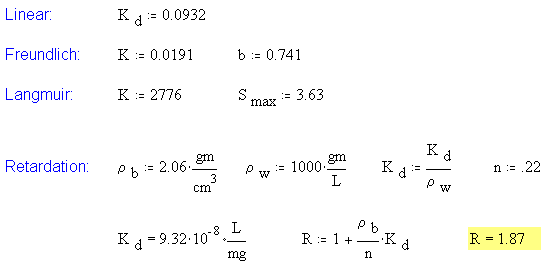
1a. determine constants for a linear, Freundlich, and Langmuir isotherms by fitting trendlines through the data points (hint: convert all concentrations to mg/mg first).
Dissolved Conc	Sorbed Conc	Dissolved Conc
(mg/L)	S (mg/mg)	(mg/mg)	C/S (mg/mg)
1.09E+00	6.57E-07	1.09E-06	1.66E+00
3.39E+00	1.97E-06	3.39E-06	1.72E+00
1.06E+01	3.85E-06	1.06E-05	2.74E+00
3.28E+01	9.72E-06	3.28E-05	3.38E+00
1.02E+02	1.83E-05	1.02E-04	5.56E+00
3.17E+02	4.93E-05	3.17E-04	6.44E+00
9.87E+02	1.08E-04	9.87E-04	9.11E+00
3.07E+03	2.78E-04	3.07E-03	1.10E+01
1b. assuming a linear isotherm, calculate a retardation coefficient assuming a bulk density of 2.06 gm/cm3 and a porosity of 22%.
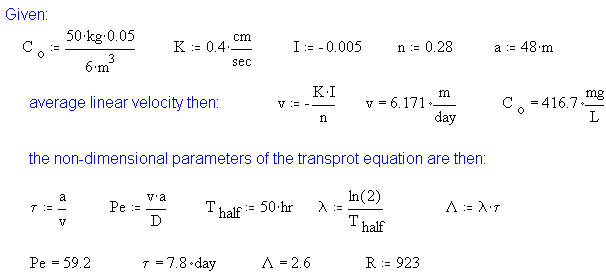
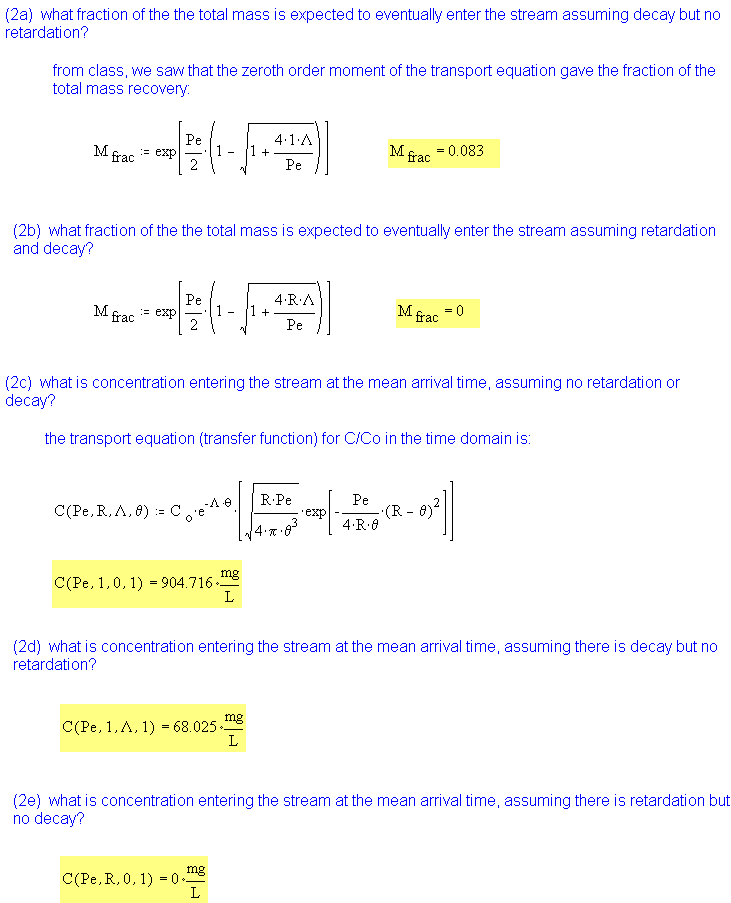
2. 50 kg of mothballs, containing 5% by weight napthelene, are illegally dumped in a sandy pit and dissolve immediately into about 6 m3 of water. You are asked to estimate possible effects to a stream, 48 m away. The conductivity of the sand is K= 0.4 cm/s, porosity is 0.28; D is 5 m2/d; the hydraulic gradient toward the stream is 0.005, R is 923 (based upon our previous calculation), and first-order rate of biodegradation half-life is estimated to be 50 hours.